Hasselblad X2D II 100C: what the new X medium format changes
Announced on 26 August 2025, the X2D II 100C keeps the 100 MP of the X2D but gains continuous autofocus, 10-stop stabilisation and full-resolution HDR. What it changes for landscape, architecture and portraiture.

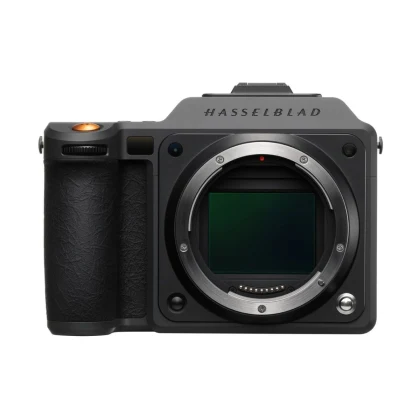
Hasselblad unveiled the X2D II 100C on 26 August 2025, alongside a new standard zoom, the XCD 2.8–4/35–100E. More than a year later, it remains the 100-megapixel body of the X range. For a photographer still hesitating over medium format, it is worth separating what has stayed the same from what has really changed.
What has stayed is the 100-megapixel sensor. Hasselblad confirmed to Fstoppers that it is the same sensor as in the first-generation X2D 100C, a 43.8 × 32.9 mm BSI CMOS, but it now extracts more from it. The brand cites a 16-bit colour depth (around 281 trillion shades), dynamic range raised to 15.3 stops and a new native sensitivity of 50 ISO. In landscape work, that 50 ISO lets you keep a moderate aperture and a longer exposure without filters, and the extra dynamic range helps preserve sky and shadow detail in a single frame.
The first real change concerns autofocus. For the first time on a Hasselblad, the body offers an AF-C mode, meaning continuous tracking, combined with subject detection based on deep learning. Phase-detection points rise from 294 to 425 zones and work together with the LiDAR rangefinder. In portraiture the difference is noticeable: a subject who moves slightly stays sharp without refocusing on every frame. Realistic expectations are still needed, however. During its test, Fstoppers noted slight focus shifts visible at 100% magnification, and the announced rate tops out at 3 frames per second. This body does not replace a sports hybrid; it simply makes medium format far more versatile.
The second change is stabilisation. The five-axis sensor-shift system now reaches 10 stops according to Hasselblad (CIPA measurement at the centre of the image, 8 stops at the edges). In practice, with 100 megapixels, even the slightest shake shows, and that is often what holds back photographers used to the tripod. For interior architecture or locations where tripods are forbidden, this margin makes handheld shooting possible at speeds that would have been unthinkable a few years ago.
The third novelty, more unexpected, is the complete HDR chain. The body processes a single exposure internally and produces HDR HEIF or Ultra HDR JPEG files, which you check on a new 3.6-inch OLED screen, tiltable 90° upwards and about 43° downwards, with a peak brightness of 1,400 nits. For a landscape photographer who shows images on screen or tablet, this recovers the brilliance of highlights right at the moment of capture. HDR images can also be edited on iPhone or iPad with the Phocus Mobile 2 app, which doubles as a wireless remote.
The rest concerns ergonomics, which matters just as much day to day. The body weighs 840 g with battery and card, 7.5% less than the X2D 100C (895 g). The grip has been redesigned, a five-way joystick makes its appearance, and eight buttons are customisable. The internal 1 TB SSD is retained and is now accompanied by a CFexpress Type B slot, which makes backing up in the field easier. The 5.76-million-dot electronic viewfinder is kept; the only drawback is the switching time between screen and viewfinder, about one second according to Fstoppers.
Finally, an advantage specific to the X system remains intact: XCD lenses with a central shutter synchronise flash at every speed, up to 1/2000 s or 1/4000 s depending on the lens (1/4000 s for the new 35–100E). For outdoor portraiture with flash, or for balancing window light in architecture, this is an advantage few competing bodies offer.
On price, the X2D II 100C is listed at €7,500 body only on Hasselblad's French site, lower than the launch price of the X2D 100C. The entry gap with a high-end full-frame hybrid has therefore narrowed, although the XCD lens range remains an investment to plan for.
For a first kit, the XCD 2.8–4/35–100E released alongside the body is a logical choice: it covers the equivalent of a 28–76 mm on full frame, weighs 894 g for a length of 138 mm, and Hasselblad describes it as the fastest focusing lens in the XCD range. On its own it covers portraiture and much of landscape work. Architecture photographers will happily complement it with a wide-angle such as the XCD 3.2–4.5/20–35E zoom.
The Hasselblad X2D II 100C is available at the shop, 59 rue Condorcet, Paris 9e (product page: see the item), as is the XCD 2.8–4/35–100E (see the item) and the XCD 3.2–4.5/20–35E (see the item). The best approach is still to come and try it with your own subjects: a portrait, a facade, an interior in low light. In a few handheld minutes, you will know whether medium format has a place in the way you photograph.