Leica M11 Monochrom: why choose a colour-free sensor
With no Bayer filter array, the 60 MP sensor of the Leica M11 Monochrom records light alone: more fine detail, a sensitivity range of 125 to 200,000 ISO and a rendering tailored to black and white. Here is what that changes and which photographers it suits.
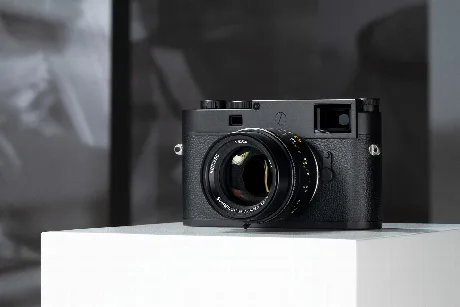
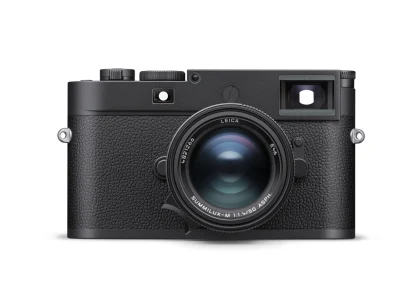
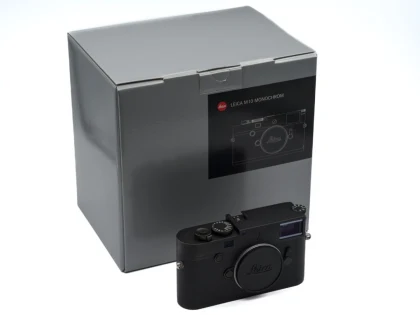
On 13 April 2023, Leica unveiled the M11 Monochrom in Wetzlar, a digital rangefinder that produces black-and-white images only. This is not an image profile or a setting: the sensor itself is designed to ignore colour. Leica has pursued this route since 2012 and the first M Monochrom, and the M11 Monochrom is the fourth generation of the line.
To understand its appeal, consider what happens on a colour sensor. The photosites of a CMOS sensor measure an amount of light, not its colour. To produce a colour image, a mosaic of filters, the Bayer filter array, is placed over them: in each group of four photosites, two record green, one red and one blue. The processor then reconstructs, by calculation (demosaicing), the information missing at each pixel. On the M11 Monochrom, this mosaic is gone. Each photosite directly records the luminance it receives, and no interpolation takes place.
The first concrete effect is fine detail. The sensor is a full-frame backside-illuminated CMOS of roughly 60 million pixels (9528 x 6328 pixels), the same design as the colour M11's. Without demosaicing, each pixel in the file corresponds to an actual measurement, free of the softening introduced by interpolation. Leica emphasises an unprecedented rendering of the finest details. Testers add nuance: current demosaicing algorithms are highly effective, and the gap, very clear at the time of the original 18-megapixel Monochrom, is less dramatic today. It shows most on large prints and with the most resolving lenses.
The second effect is sensitivity. Coloured filters absorb part of the light; without them, each photosite receives more. Base sensitivity thus rises from 64 ISO on the M11 to 125 ISO on the Monochrom, and the range extends up to 200,000 ISO. Since there is no colour to reconstruct, noise never takes the form of coloured blotches, and published tests describe particularly clean files. For you, this means working indoors, at concerts or in the street after dark without sacrificing quality. And if a base of 125 ISO worries you when opening wide in bright sun, the electronic shutter, reaching 1/16,000 s, means a neutral density filter is unnecessary in most cases.
The third effect is rendering. Leica pairs the sensor with a double-layer absorption filter glass and highlights dynamic range and the richness of greys. The DNG file contains only luminance information: you work the greyscale directly, with no conversion from colour. This also changes how you shoot. As in the days of black-and-white film, coloured filters screwed onto the lens regain their full purpose: a yellow or orange darkens a blue sky, a red makes it very dense, a green lightens foliage. The translation of colours into greys is decided at the moment of capture, not at development.
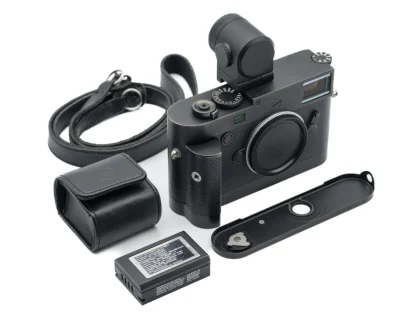
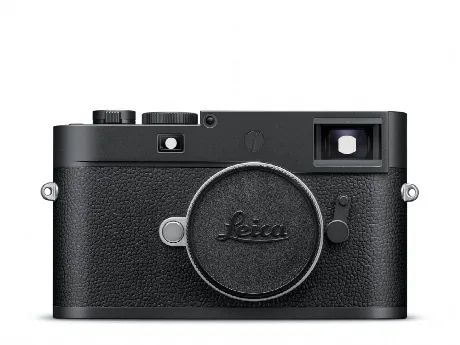
The rest of the body follows the M11 platform: rangefinder viewing and manual focusing, with focus peaking aids on the screen in live view, a choice of three resolutions (60, 36 or 18 megapixels, in DNG as well as JPEG, always using the whole sensor surface), exposures up to one hour, and metering performed by the sensor. The Monochrom stands out with 256 GB of internal memory, a sapphire-glass protected screen and a deliberately understated presentation: no red logo, and a viewfinder finished in dark chrome. Images transfer to a smartphone or tablet via the Leica FOTOS app, by Bluetooth or by USB-C cable. Its recommended retail price in France is currently 9,750 EUR.
For whom? First of all for those who already think in black and white: street, reportage or documentary photographers who never deliver their images in colour and want the best possible file for that idiom. Then for low-light photographers, who value the discretion of a rangefinder and the margin offered by high sensitivities. Finally for anyone seeking maximum detail from a 24 x 36 sensor, in architecture or landscape. The choice remains demanding: colour can never be recovered afterwards. If your commissions may require colour, an M11 in colour, alone or as a second body, remains the logical tool.
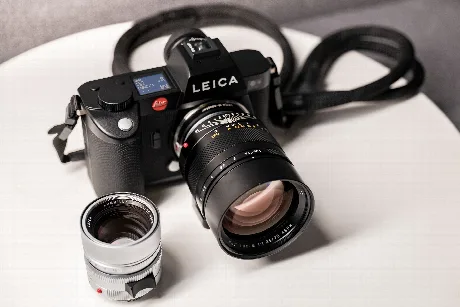
The Leica M11 Monochrom is available at the shop (see the item), 59 rue Condorcet, Paris 9e. To make the most of its sensitivity, the Noctilux-M 50 mm f/0.95 ASPH, also available (see the item), forms a natural pairing: wide aperture and 200,000 ISO push the limits of available-light photography a long way. And if you are torn between black and white and colour, the Leica M11 in gloss black finish (see the item) is also available: come and compare the two bodies in hand and look at their files side by side with us.