Alpa 12 TC and 12 Plus: the Swiss view camera and its 2026 news
From the Alpa 12 TC and 12 Plus to Phase One or Hasselblad backs, here is how the Swiss technical camera serves architecture and landscape. And what marks the year 2026 at Alpa, from the brand's 80th anniversary to the Edition Pignons Glacier Silver.
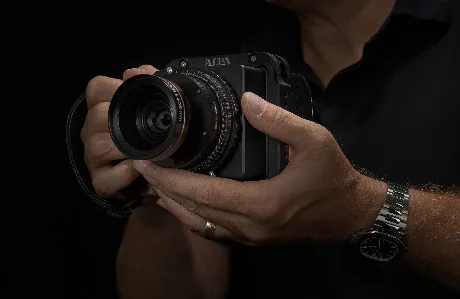
Some cameras are chosen for their speed, others for the way they force you to look. Alpa technical cameras clearly belong to the second family. Made in Switzerland by Alpa of Switzerland, they have served architecture, landscape, still life and art photographers for nearly thirty years, people who seek flawless geometry and total control over perspective.
The name Alpa is older than the camera itself. It comes from Swiss watchmaking: the firm Pignons, a maker of watch components, had entrusted engineer Jacques Bolsey, father of the Bolex camera, with designing a camera; the Alpa trademark was registered in 1946 and Alpa SLR cameras were produced until 1990. The brand was later taken over in 1996 by Ursula Capaul and Thomas Weber, who chose not to revive the 24x36 SLR but to design a modular medium format system, the Alpa 12. The first study was shown at Photokina in 1996. From the outset, the idea was to accept both film backs and digital backs from various manufacturers. Since the 2022 transfer, the company remains an independent Swiss manufacturer under the name Alpa of Switzerland AG.
In practice, an Alpa 12 is a rigid body that links a large image circle lens, mounted in its shutter or aperture unit, to a back. No mirror, no autofocus: focusing is done by scale or by viewing on the back's screen, and the shifts and tilts are set by hand. This stripped-down design is what gives the system its precision.
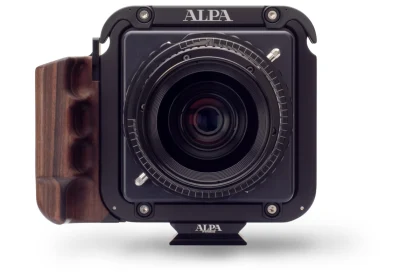
The Alpa 12 TC (for Travel Compact) is its most compact form. The body weighs 220 g and measures 110 x 110 mm, roughly the footprint of a coaster. It has no built-in movements, but adapters allow up to 5° of tilt or swing, and up to 10° with lenses in the SB 34 mount. Through dedicated adapters it accepts current digital backs as well as film backs up to 6x9, and pairs with Schneider, Rodenstock or Zeiss optics. For landscape work on foot, or for anyone who wants to discover the system without the bulk, it is often the most sensible entry point.
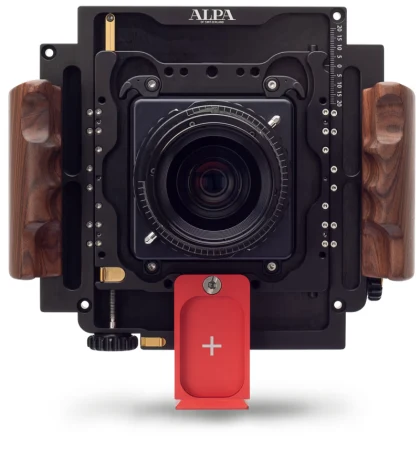
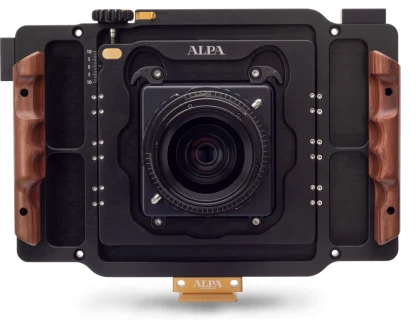
At the other end, the Alpa 12 Plus, introduced in 2018, is the most versatile body in the range. Its symmetrical cross-shaped form gives it its name: it offers 20 mm of rise and fall on the lens plane, and 20 mm of horizontal shift on either side on the sensor plane, with independent, combinable movements. For architecture, this means straightening a façade without tilting the camera; for landscape or studio work, stitching several shifted views into a wider, more detailed image without parallax. Four individually calibrated spirit levels and small spring dampers, which protect lens and back from shocks, complete a body weighing 1040 g for 184 x 184 mm. For assembled panoramas, the Alpa 12 Pano goes further still, with 35 mm of horizontal shift on each side, preset detents included, and 10 mm of rise and fall.
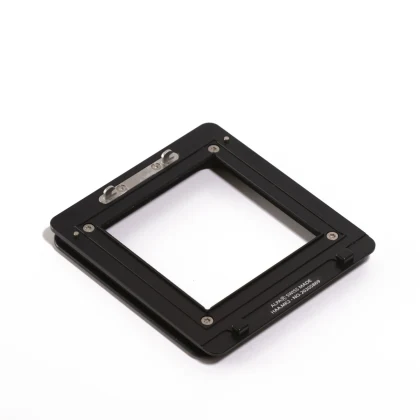
On the sensor side, the system's openness remains its great asset. Alpa announces that its bodies are compatible with Phase One and Hasselblad digital backs, and the Hasselblad CFV 100C back, with its 100 megapixels, mounts via the Alpa HAA Mk II adapter. It is a configuration we like to show in the shop: the Hasselblad 907X 100C, which combines this back and its small body, is available with us (see the item), and the same back can work alone on that body or, with the right adapter, on an Alpa view camera.
Now to the news. In 2026, Alpa celebrates the 80th anniversary of its brand. For the occasion, it opened a temporary showroom in Arles from 6 to 10 July 2026, during the opening week of the Rencontres de la photographie, where the Edition Pignons models were on display. This limited series in Glacier Silver finish, presented in 2025, pays tribute to the brand's watchmaking origins. It is offered in two sets, built around the Alpa 12 STC and 12 SWA, each limited to 99 units, with black rosewood grips, leather straps and a signed, numbered certificate. According to Alpa, achieving this finish required reworking each mechanical part to maintain tolerances of around two-hundredths of a millimetre. A limited selection of matching lenses accompanies it, sold separately.
On 28 February 2026, Alpa also published a text on its heritage, recalling that the 1996 study drew inspiration from the Ermanox, and that it still defends a photography based on physical controls rather than the touchscreen. Alpa cameras also continue to serve commercial commissions: Swiss photographer Kostas Maros shot the Götti eyewear campaign on Alpa, presented by Alpa in June 2026 with the Alpa 12 Max among the equipment cited.
At the shop, at 59 rue Condorcet in the 9th arrondissement of Paris, you will find the Alpa 12 Plus (see the item) and the Alpa 12 Edition Pignons STC Glacier Silver set (see the item). An Alpa camera is assembled like a made-to-measure instrument: body, lenses, adapters, back. The simplest approach is to come with your images and your favourite subjects, so that we can build together the configuration that suits them.